Clipping details
|
| Title: | The salvation of Ruth Siegenthaler |
| Notes: | A warts and all article about following Quo for two Swiss gigs in 1975 |
| Year: | 1975 |
| Country: | UK |
| Publication: | New Musical Express |
| Author: | Tony Stewart |
The salvation of Ruth Siegenthaler
A POIGNANT STORY OF THE GOOD WORKS OF STATUS QUO
- who straightened out a Swiss chick hell-bent for oblivion, and also (much less commendable, this) indulge in picking their noses
RUTH SIEGENTHALER will arrive in this country next month to study English at a Brighton College, and in denim bag she'll carry the Diploma she received on the successful completion of a commercial course in Switzerland. She maintains though, that none of this would have been possible if she hadn't been introduced to the music of Status Quo.
The band have been, she says, her saviours.
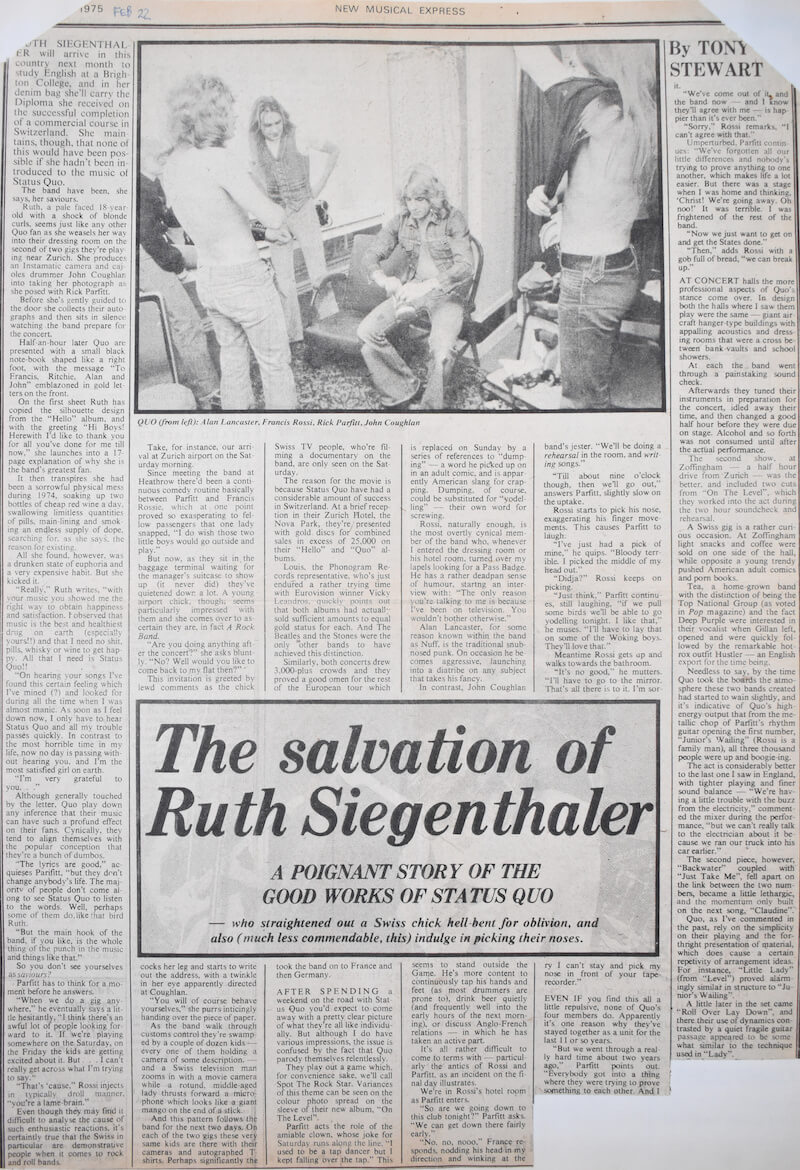
Ruth, a pale faced 18-year-old with a shock of blonde curls, seems just like any other Quo fan as she weasels her way into their dressing room on the second of two gigs they're playing near Zurich. She produced an Instamatic camera and cajoles drummer John Coughlan (sic) into taking her photograph as she posed with Rick Parfitt.
Before she's gently guided to the door she collects their autographs and then sits in silence watching the band prepare for the concert.
Half-an-hour later Quo are presented with a small black note-book shaped like a right foot, with the message "To Francis, Ritchie, Alan and John" emblazoned in gold letters on the front.
On the first sheet Ruth has copied the silhouette design from the "Hello" album, and with the greeting "Hi Boys! Herewith I'd like to thank you for all you've done for me till now," she launches into a 17-page explanation of why she is the band's greatest fan.
It then transpires she had been a sorrowful physical mess during 1974, soaking up two bottles of cheap red wine a day, swallowing limitless quantities of pills, main-lining and smoking an endless supply of dope, searching for, as she says, the reason for existing.
All she found, however, was a drunken state of euphoria and a very expensive habit. But she kicked it.
"Really," Ruth writes, "with your music you showed me the right way to obtain happiness and satisfaction. I observed that music is the best and healthiest drug on earth (especially yours!!) and that I need no shit, pills, whisky or wine to get happy. All that I need is Status Quo!!
"On hearing your songs I've found this certain feeling which I've mined (?) and looked for during all the time when I was almost manic. As soon as I feel down now, I only have to hear Status Quo and all my trouble passes quickly. In contrast to the most horrible time in my life, now no day is passing without hearing you, and I'm the most satisfied girl on earth.
"I'm very grateful to you..."
Although generally touched by the letter, Quo play down any inference that their music can have such a profound effect on their fans. Cynically, they tend to align themselves with the popular conception that they're a bunch of dumbos.
"The lyrics are good," acquieses Parifitt (sic), "but they don't change anybody's life. The majority of people don't come along to see Status Quo to listen to the words. Well, perhaps some of them do, like that bird Ruth.
"But the main hook of the band, if you like, is the whole thing of the punch in the music and things like that."
So you don't see yourselves as saviours?
Parfitt has to think for a moment before he answers.
"When we do a gig anywhere," he eventually says a little hesitantly, "I think there's an awful lot of people looking forward to it. If we're playing somewhere on the Saturday, on the Friday the kids are getting excited about it. But... I can't really get across what I'm trying to say."
"That's 'cause," Rossi injects in typically droll manner, "you're a lame-brain."
Even though they may find it difficult to analyse the cause of such enthusiastic reactions, it's certainly true that the Swiss in particular are demonstrative people when it comes to rock and roll bands.
Take, for instance, our arrival at Zurich airport on the Saturday morning.
Since meeting the band at Heathrow there'd been a continuous comedy routine basically between Parfitt and Francis Rossie (sic), which at one point proved so exasperating to fellow passengers that one lady snapped, "I do wish those two little boys would go outside and play."
But now, as they sit in the baggage terminal waiting for the manager's suitcase to show up (it never did) they've quietened down a lot. A young airport chick, though, seems particularly impressed with them and she comes over to ascertain they are, in fact A Rock Band.
"Are you doing anything after the concert?" she asks bluntly. "No? Well would you like to come back to my flat then?"
This invitation is greeted by lewd comments as the chick cocks her leg and starts to write out the address, with a twinkle in her eye apparently directed at Coughlan. (sic)
"You will of course behave yourselves," she purrs inticingly (sic) handing over the piece of paper.
As the band walk through customs control they're swamped by a couple of dozen kids - every one of them holding acamera of some description. - and a Swiss television man zooms in with a movie camera while a rotund, middle-aged lady thrusts forward a microphone which looks like a giant mango on the end of a stick.
And this pattern follows the band for the next two days. On each of the two gigs these very same kids are there with their cameras and autographed T-shirts. Perhaps significantly the Swiss TV people, who're filming a documentary on the band, are only seen on the Saturday.
The reason for the movie is because Status Quo have had a considerable amount of success in Switzerland. At a brief reception in their Zurich Hotel, the Nova Park, they're presented with gold discs for combined sales in excess of 25,000 on their "Hello" and "Quo" albums.
Louis, the Phonogram Records representative, who's just endured a rather tryingtie with Eurovision winner Vicky Leandros, quickly points out that both albums had actually sold sufficient amounts to equal gold status for each. And The Beatles and the Stones were the only other bands to have achieved this distinction.
Similarly, both concerts drew 3,000-plus crowds and they proved a good omen for the rest of the European tour which took the band on to France and then Germany.
AFTER SPENDING a weekend on the road with Status Quo you'd expect to come away with a pretty clear picture of what they're all like individually. But although I do have various impressions, the issue is confused by the fact that Quo parody themselves relentlessly.
They play out a game which, for convenience sake, we'll call Spot The Rock Star. Variances of this theme can be seen on the colour photo spread on the sleeve of their new album, "On The Level".
Parfitt acts the role of the amiable clown, whose joke for Saturday runs along the line, "I used to be a tap dancer but I kept falling over the tap." This is replaced on Sunday by a series of references to "dumping" - a word he picked up on in an adult comic, and is apparently American slang for crapping. Dumping, of course, could be substituted for "yodelling" - their own word for screwing.
Rossi, naturally enough, is the most overtly cynical member of the band who, whenever I entered the dressing room or his hotel room, turned over my lapels looking for a Pass Badge. He has a rather deadpan sense of humour, startng an interview with: "The only reason you're talking to me is because I've been on television. You wouldn't bother otherwise."
Alan Lancaster, for some reason known within the band as Nuff, is the traditional snub-nosed punk. On occasion he becomes aggressive, launching into a diatribe on any subject that takes his fancy.
In contrast, John Coughlan (sic) seems to stand outside the Game. He's more content to continuously tap his hands and feet (as most drummers are prone to), drink beer quietly (and frequently well into the early hours of the next morning), or discuss Anglo-French relations- in which he has taken an active part.
It's all rather difficult to come to terms with - particularly the antics of Rossi and Parfitt, as an incident on the final day illustrates.
We're in Rossi's hotel room as Parfitt enters.
"So are we down to this club tonight?" Parfitt asks. "We can get down there fairly early."
"No, no, nooo," France responds, nodding his head in my direction and winking at the band's jester. "We'll be doing a rehearsal in the room, and writing songs."
"Till about nine o'clock though, then we'll go out," answers Parfitt, slightly slow on the uptake.
Rossi starts to pick his nose, exaggerating his finger movements. This causes Parfitt to laugh.
"I've just had a pick of mine," he quips. "Bloody terrible. I picked the middle of my head out."
"Didja?" Rossi keeps on picking.
"Just think," Parfitt continues, still laughing, "if we pull some birds we'll be able to go yodelling tonight. I like that'" he muses. "I'll have to lay that on some of the Woking boys. They'll love that."
Meantime Rossi gets up and walks towards the bathroom.
"It's no good," he mutters. "I'll have to go to the mirror. That's all there is to it. I'm sorry I can't stay and pick my nose in front of your tape-recorder."
EVEN IF you find this all a little repulsive. none of Quo's four members do. Apparently it's one reason why they've stayed togetner as a unit for the last 11 or so years."But we went through a really hard time about two years ago," Parfitt points out. "Everybody got into a thing where they were trying to prove something to each other. And I (missing) it.
"We've come out of it and the band now - and I know they'll agree with me - is happier than it's ever been."
"Sorry," Rossi remarks, "I can't agree with that."
Umperturbed, Parfitt continues: "We've forgotten all our little differences and nobody's trying to prove anything to one another, which makes life a lot easier. But there was a stage when I was home and thinking, 'Christ! We're going away. Oh noo!' It was terrible. I was frightened of the rest of the band.
"Now we just want to get on and get the States done."
"Then," adds Rossi with a gob full of bread, "we can break up."
AT CONCERT halls the more professional aspects of Quo's stance come over. In design both the halls where I saw them play were the same - giant aircraft hanger-type buildings with appalling acoustics and dressing rooms that were a cross between bank-vaults and school showers.
At each the band went through a painstaking soundcheck.Afterwards they tuned their instruments in preparation for the concert, idled away their time, and then changed a good half hour before they were due on stage. Alcohol and so forth was not consumed until after the actual performance.
The second show at Zoffingham - a half hour drive from Zurich - was the better, and included two cuts from "On The Level", which they worked into the act during the two hour soundcheck and rehearsal.
A Swiss gig is a rather curious occasion. At Zoffingham light snacks and coffee were sold on one side of the hall, while opposite a young trendy pushed American adult comics and porn books.
Tea, a home-grown band with the distinction of being the Top National Group (as voted in Pop magazine) and the fact Deep Purple were interested in their vocalist when Gillan left, opened and were quickly followed by the remarkable hot-rox outfit Hustler - an English export for the time being.
Needless to say, by the time Quo took the boards the atmosphere these two bands created had started to wain slightly, and it's indicative of Quo's high-energy output that from the metallic chop of Parfitt's rhythm guitar opening the first number, "Junior's Wailing" (Rossi is a family man), all three thousand people were up and boogie-ing.
The act is considerably better to the last one I saw in England, and finer sound balance - "We're having a little trouble with the buzz from the electricity," commented the mixer during the performance, "but we can't really talk to the electrician about it because we ran our truck into his car earlier."
The second piece, however, "Backwater" coupled with "Just Take Me", fell apart on the link between the two numbers, became a little lethargic, and the momentum only built on the next song, "Claudine"(sic).
Quo, as I've commented in the past, rely on the simplicity on their playing and the forthright presentation of material, which does cause a certain repetivity (sic) of arrangement ideas. For instance, "Little Lady" (from "Level") proved alarmingly similar in structure to "Junior's Wailing".
A little later in the set came "Roll Over Lay Down", there their use of dynamics contrasted by a quiet fragile guitar passage appeared to be somewhat similar to the technique used in "Lady".
Image caption: QUO (from left): Alan Lancaster, Francis Rossi, Rick Parfitt, John Coughlan (sic)