Clipping details
|
| Title: | Old men in boys' clothes has gone beyond a joke' |
| Notes: | Review of the "Whatever You Want" album |
| Year: | 1979 |
| Country: | UK |
| Publication: | Melody Maker |
| Author: | Harry Doherty |
'Old men in boys' clothes has gone beyond a joke'
STATUS QUO: "Whatever You Want" (Vertigo 9102 037)
THE title may be construed in some areas as Status Quo's capitulation to their critics, who've been claiming for donkey's years that the band's appeal has been their constant predictability: you gets what you wants for your pennies. I doubt, though, whether the Quo could be so consciously cynical. The band act on instincts, and their instincts tell them that this is what their fans want.
Their instincts, mind you, also tell them that their fans might want T-shirts, badges, patches, sweat-shirts and satin' jackets, and so they include a sales brochure in the album sleeve. At about 20 quid for jacket, £6 for a sweat shirt and £3.50 for a T-shirt, you might feel that they're stretching the resources of their loyal following a bit far.
What, you might ask, has that got to do with a review of the new Status Quo album? A lot. Quo and their associates have refined the art of packaging. "Special offer with your BIG! NEW! Status Quo album this week. Buy FAST! while stocks LAST!"
The marketing strategy could be forgiven if the band made up for it in the musical content - but, unfortunately, the music here is sold as part of the package when, in fact, it should have been distinctly placed above it. This makes it even harder to escape from the conclusion that the organisation is out to burn as big a hole in the pocket as possible.
One remembers how when Quo brought out "Blue For You" a couple of years ago, they signed a marketing deal with Brutus Jeans. That, I felt, was typically humorous, but this time they carry the side-effects a mile too far.
If I'm not mistaken, some of this album was recorded at the same time as "If You Can't Stand The Heat," taped almost a year ago; if that's so, it emphasises again the pure business nature of Quo's commitment these days, I prefer to think that the band's motives are more genuinely musical, that perhaps they're aware of the tradition they've established as the best British boogie band.
The title-track has Quo at their most devastating on a Rick Parfitt/Andy Bown song. Starting slowly with a hugging chord structure, it moves smartly into the beloved 12-bar routine that smashes the original melancholy to pieces. Parfitt once more reinforces his claim as the most pertinent writer in the band. While Frances Rossi dabbled with country and generally softened his heart, Parfitt emerged with a backbone of steel, but is still capable of penning uncharacteristic ballads, like the introspective "Living On An Island," a desolate picture of the other side of glamour.
Rossi, though, is far from dozing, and contributes the two roasting tracks that open the second side, "Come Rock With Me" and "Rockin' On," both with the astute blend of hard rock and pop that made earlier classics of "Down Down" and "Caroline".
The second side is generally far superior, with Rossi contributing another fine song in "Runaway," Alan Lancaster and Bob Young donating "High Flyer" and Rossi, Parfitt and Bown combining to close with "Breaking Away," all played with energetic Quo panache.
Ironically, it's the final track, "Breaking Away," that's the most significant in the light of the earlier comments about Quo's business sense. In a tone that seems almost rebellious, Rossi and Parfitt refer to disillusionment with their persornal financial affairs, life on the road and their image of eternal youth: "Old men in boys' clothes/Has gone beyond a joke." The final chorus asserts: "But I'm changing my tune now/ And I'm breaking away."
Could this, then be the final Status Quo album? - HARRY DOHERTY.
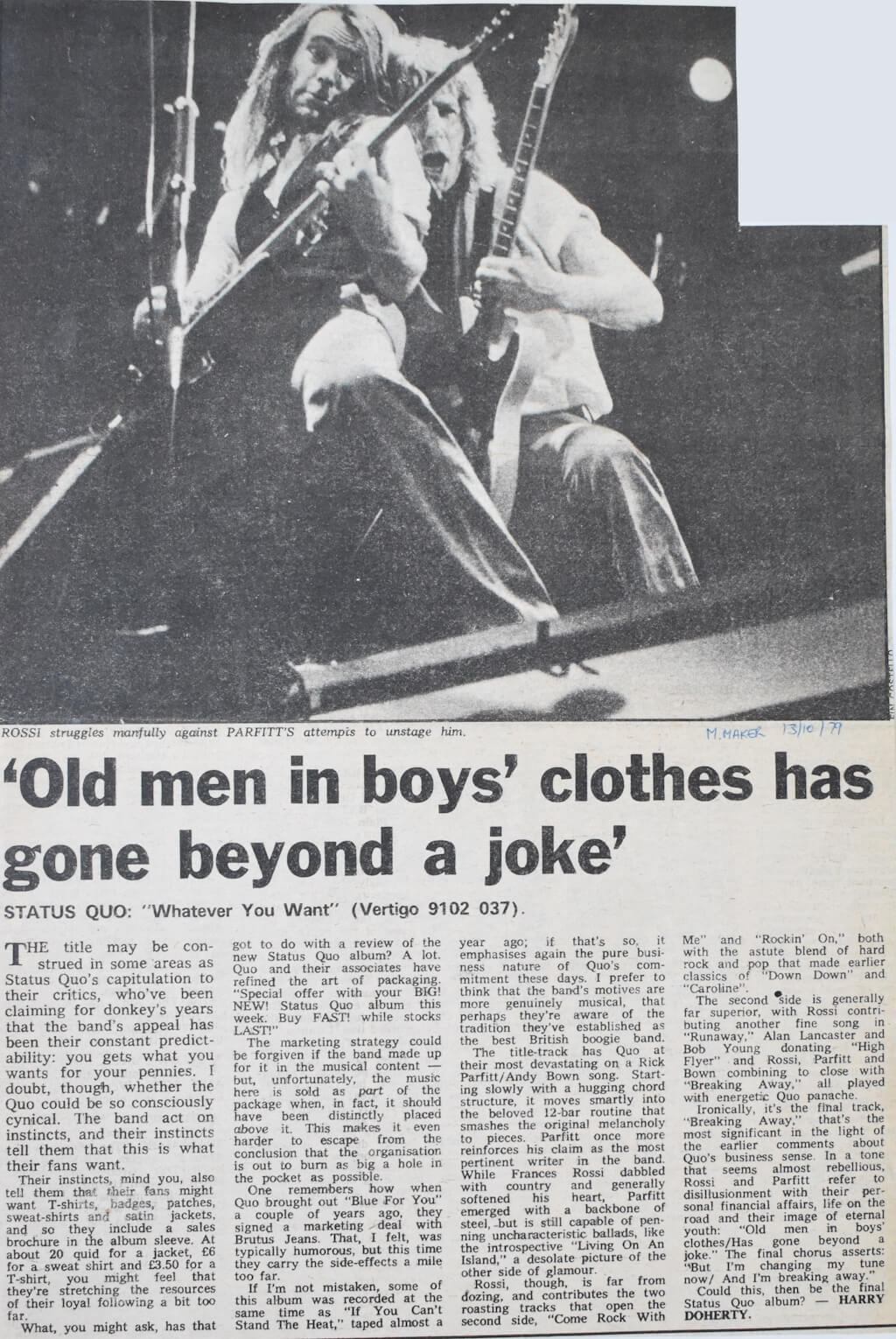
Image caption: ROSSI struggles manfully against PARFITT'S attempts to unstage him.