Clipping details
|
| Title: | Status Symbol |
| Notes: | Interview with Francis |
| Year: | 1973 |
| Country: | US |
| Publication: | Disc |
| Author: | Robert Brinton |
Status Symbol
by ROBERT BRINTON
Edited by Caroline Boucher
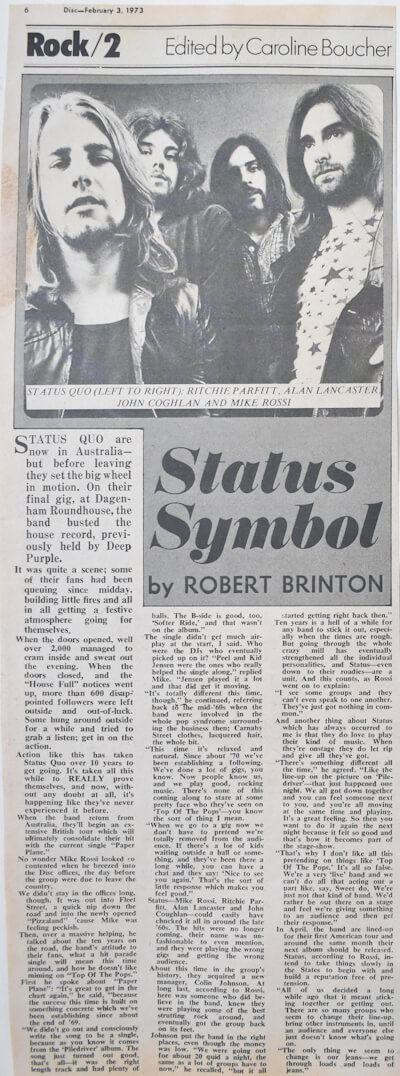
STATUS QUO are now in Australia - but before leaving they set the big wheel in motion. On their final gig, at Dagenham Roundhouse, the band busted the house record, previously held by Deep Purple.
It was quite a scene; some of their fans had been queuing since midday, building little fires and all in all getting a festive atmosphere going for themselves.
When the doors opened, well over 2,000 managed to cram inside and sweat out the evening. When the doors closed, and the "House Full" notices went up, more than 600 disappointed followers were left outside and out-of-luck. Some hung around outside for a while and tried to grab a listen; get in on the action.
Action like this has taken Status Quo over 10 years to get going. It's taken all this while to REALLY prove themselves, and now, without any doubt at all, it's happening like they've never experienced it before.
When the band returns from Australia, they'll begin an extensive British tour which will ultimately consolidate their hit with the current single "Paper Plane."
No wonder Mike Rossi looked so contented when he breezed into the Disc offices, the day before the group were due to leave the country.
We didn't stay in the offices long, though. It was out into Fleet Street, a quick nip down the road and into the newly opened "Pizzaland" cause Mike was feeling peckish.
Then, over a massive helping, he talked about the ten years on the road, the band's attitude to their fans, what a hit parade single will mean this time around, and how he doesn't like miming on "Top Of The Pops."
First he spoke about "Paper Plane": "It's great to get in the chart again," he said, "because the success this time is built on something concrete which we've been establishing since about the end of '69.
"We didn't go out and consciously write the song to be a single, because as you know it comes from the "Piledriver" album, The song just turned out right, that's all - it was the right length track and had plenty of balls. The B-side is good too, "Softer Ride,' and that wasn't on the album.
The single didn't get much airplay at the start, I said. Who were the DJs who eventually picked up on it? "Peel and Kid Jensen were the ones who really helped the single along,", replied Mike. "Jensen played it a lot and that got it moving.
"It's totally different this time, though," he continued, referring back to the mid-'60s when the band were involved in the whole pop syndrome surrounding the business then; Carnaby Street clothes, lacquered hair, the whole bit.
"This time, it's relaxed and natural. Since about '70, we've been establishing a following. We've done a lot of gigs, you know. Now people know us and we play good, rocking music. There's none of this coming along to stare at some pretty face they've seen on 'Top of the Pops' - you know the sort of thing I mean.
"When we go to a gig now, we don't have to pretend we're totally removed from the audience. If there's a lot of kids waiting outside a hall or something, and they've been there a long while, you can have a chat and they say: 'Nice to see you again.' That's the sort of little response which makes you feel good."
Status - Mike Rossi, Ritchie Parfitt, Alan Lancaster and John Coghlan - could easily have chucked it all in around the late '60s. The hits were no longer coming, their name was unfashionable to even mention and they were playing the wrong gigs and getting the wrong audience.
About this time in the group's history, they acquired a new manager, Colin Johnson. At long last, according to Rossi, was someone who did believe in the band, knew they were playing some of the best strutting rock around, and eventually got the group back back on its feet.
Johnson put the band in the right places, even though the money was low. "We were going out for about 20 quid a night, the same as a lot of groups have to now," he recalled, "but it all started getting right back then."
"Ten years is a hell of a while for any pand to stick it out, especially when the times are rough. But going through the whole crazy mill has eventually strengthened all the individual personalities, and Status - even down to the roadies - are a unit. And this counts, as Rossi went on the explain:
"I see some groups and they can't even speak to one another. They've just got nothing in common."
And another thing about Status which has always occurred to me is that they do love to play their kind of music. When they're onstage, they do let rip and gve all they've got.
"There's something different all the time," he agreed. "Like the line-up on the picture on 'Piledriver' - that just happened one night. We all got down together and you can feel someone next to you and you're all moving at the same time and playing. It's a great feeling. So then you want to do it again the next night because it felt so good and that's how it becomes part of the stage-show.
"That's why I don't like all this pretending on things like "Top Of The Pops." It's all so false. We're a very 'live' band and we can't do all that acting out a part like, say, Sweet do. We're just not that kind of band. We'd rather be out there on a stage and feel we're giving something to an audience and then get their response.
In April, the band are lined-up for their first American tour and around the same month their next album should be released. Status, according to Rossi, intend to take things slowly in the States to begin with and build a reputation free of pretension.
"All of us decided a long while ago that it meant sticking together or getting out. There are so many groups who seem to change their line-up, bring other instruments in, until an audience and everyone else just doesn't know what's going on.
"The only thing we seem to change is our jeans - we get through loads and loads of jeans."
Image caption: STATUS QUO (LEFT TO RIGHT): RITCHIE PARFITT, ALÀN LANCASTER, JOHN COGHLAN AND MIKE ROSSI