Clipping details
|
| Title: | Keeping The Score |
| Notes: | Interview with Francis about 20th anniversary |
| Year: | |
| Country: | UK |
| Publication: | |
| Author: | Chas De Whalley |
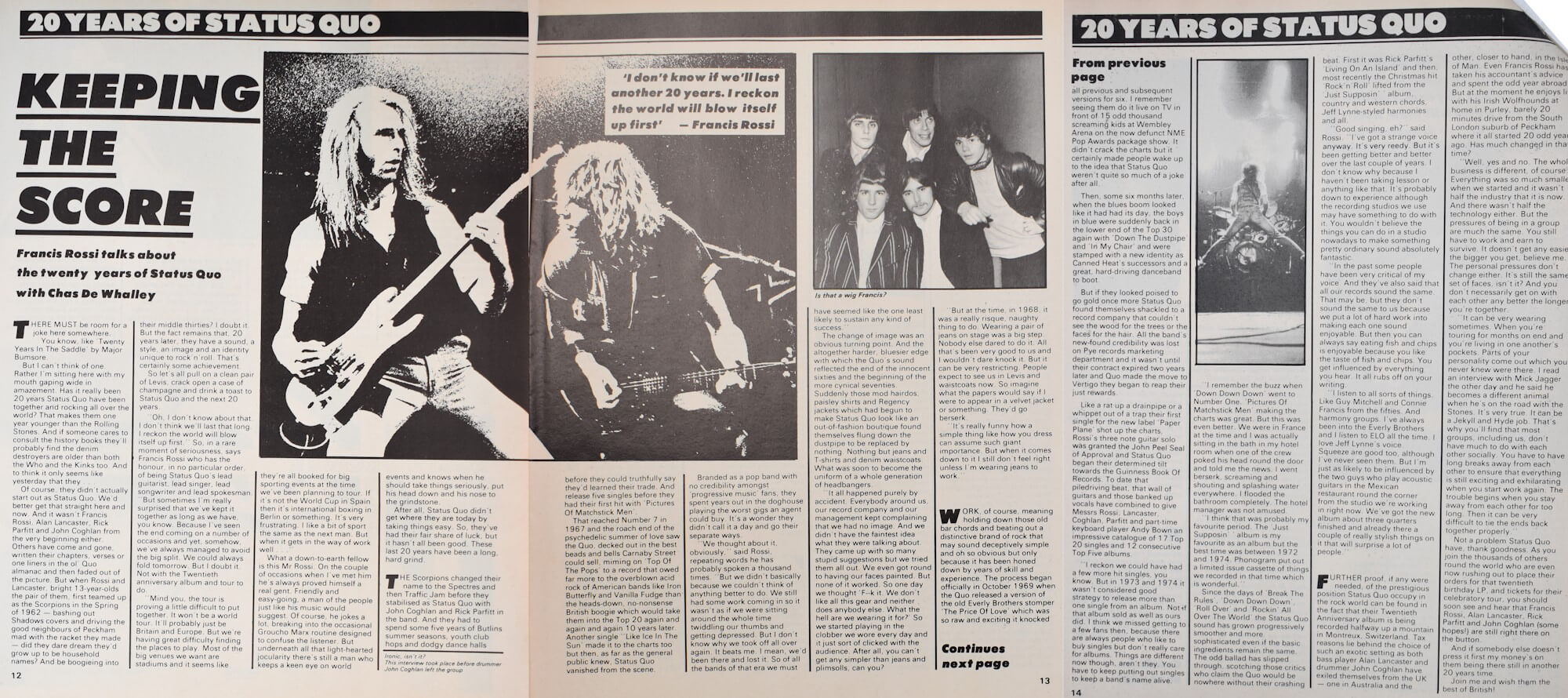
20 YEARS OF STATUS QUO
KEEPING THE SCORE
Francis Rossi talks about the twenty years of Status Quo with Chas De Whalley
THERE MUST be room for a joke here somewhere. You know, like 'Twenty Years In The Saddle' by Major Bumsore.
But I can't think of one.
Rather I'm sitting here with my mouth gaping wide in amazement. Has it really been 20 years Status Quo have been together and rocking all over the world? That makes them one year younger than the Rolling Stones. And if someone cares to consult the history books they'll probably find the denim destroyers are older than both the Who and the Kinks too. And to think it only seems like yesterday that they...
Of course, they didn't actually start out as Status Quo. We'd better get that straight here and now. And it wasn't Francis Rossi, Alan Lancaster, Rick Parfitt and John Coghlan from the very beginning either. Others have come and gone, written their chapters, verses or one liners in the ol' Quo almanac and then faded out of the picture. But when Rossi and Lancaster, bright 13-year-olds the pair of them, first teamed up as the Scorpions in the Spring of 1962 - bashing out Shadows covers and driving the good neighbours of Peckham mad with the racket they made - did they dare dream they'd grow up to be household names? And be boogieing into their middle thirties? I doubt it. But the fact remains that, 20 years later, they have a sound, a style, an image and an identity unique to rock'n'roll. That's certainly some achievement.
So let's all pull on a clean pair of Levis, crack open a case of champagne and drink a toast to Status Quo and the next 20 years.
"Oh, I don't know about that. I don't think we'll last that long. I reckon the world will blow itself up first." So, in a rare moment of seriousness, says Francis Rossi who has the honour, in no particular order, of being Status Quo's lead guitarist, lead singer, lead songwriter and lead spokesman. "But sometimes I'm really surprised that we've kept it together as long as we have you know. Because I've seen the end coming on a number of occasions and yet, somehow, we've always managed to avoid the big split. We could always fold tomorrow. But I doubt it. Not with the Twentieth anniversary album and tour to do. [Ed - Ironic, isn't it? This interview took place before drummer John Coghlan left the group]
Mind you, the tour is proving a little difficult to put together. It won't be a world tour. It'll probably just be Britain and Europe. But we're having great difficulty finding the places to play. Most of the big venues we want are stadiums and it seems like they're all booked for big sporting events at the time we've been planning to tour. If it's not the World Cup in Spain then it's international boxing in Berlin or something. It's very frustrating. I like a bit of sport the same as the next man. But when it gets in the way of work well..." What a down-to-earth fellow is this Mr Rossi. On the couple of occasions when I've met him he's always proved himself a real gent. Friendly and easy-going, a man of the people just like his music would suggest. Of course, he jokes a lot, breaking into the occasional Groucho Marx routine designed to confuse the listener. But underneath all that light-hearted jocularity there's still a man who keeps a keen eye on world events and knows when he should take things seriously, put his head down and his nose to the grindstone.
After all, Status Quo didn't get where they are today by taking things easy. So, they've had their fair share of luck, but it hasn't all been good. These last 20 years have been a long, hard grind.
THE Scorpions changed their name to the Spectres and then Traffic Jam before they stabilised as Status Quo with John Coghlan and Rick Parfitt in the band. And they had to spend some five years of Butlins summer seasons, youth club hops and dodgy dance halls before they could truthfully say they'd learned their trade. And release five singles before they had their first hit with 'Pictures Of Matchstick Men'.
That reached Number 7 in 1967 and the roach end of the psychedelic summer of love saw the Quo, decked out in the best beads and bells Carnaby Street could sell, miming on 'Top Of The Pops' to a record that owed far more to the overblown acid rock of American bands like Iron Butterfly and Vanilla Fudge than the heads-down, no-nonsense British boogie which would take them into the Top 20 again and again and again 10 years later. Another single "Like Ice In The Sun' made it to the charts too but then, as far as the general public knew, Status Quo vanished from the scene.
Branded as a pop band with no credibility amongst 'progressive music' fans, they spent years out in the doghouse playing the worst gigs an agent could buy. It's a wonder they didn't call it a day and go their separate ways.
"We thought about it, obviously," said Rossi, repeating words he has probably spoken a thousand times. "But we didn't basically because we couldn't think of anything better to do. We still had some work coming in so it wasn't as if we were sitting around the whole time twiddling our thumbs and getting depressed. But I don't know why we took off all over again. It beats me. I mean, we'd been there and lost it. So of all the bands of that era we must have seemed like the one least likely to sustain any kind of success."
The change of image was an obvious turning point. And the altogether harder, bluesier edge with which the Quo's sound reflected the end of the innocent sixties and the beginning of the more cynical seventies. Suddenly those mod hairdos, paisley shirts and Regency jackets which had begun to make Status Quo look like an out-of-fashion boutique found themselves flung down the dustpipe to be replaced by nothing. Nothing but jeans and T-shirts and denim waistcoats. What was soon to become the uniform of a whole generation of headbangers.
"It all happened purely by accident. Everybody around us, our record company and our management kept complaining that we had no image. And we didn't have the faintest idea what they were talking about. They came up with so many stupid suggestions but we tried them all out. We even got round to having our faces painted. But none of it worked. So one day we thought 'F--k it. We don't like all this gear and neither does anybody else. What the hell are we wearing it for?' So we started playing in the clobber we wore every day and it just sort of clicked with the audience. After all, you can't get any simpler than jeans and plimsolls, can you?
"But at the time, in 1968, it was a really risque, naughty thing to do. Wearing a pair of jeans on stage was a big step. Nobody else dared to do it. All that's been very good to us and I wouldn't dare knock it. But it can be very restricting. People expect to see us in Levis and waistcoats now. So imagine what the papers would say if I were to appear in a velvet jacket or something. They'd go berserk.
"It's really funny how a simple thing like how you dress can assume such giant importance. But when it comes down to it I still don't feel right unless I'm wearing jeans to work."
WORK, of course, meaning holding down those old bar chords and beating out a distinctive brand of rock that may sound deceptively simple and oh so obvious but only because it has been honed down by years of skill and experience. The process began officially in October 1969 when the Quo released a version of the old Everly Brothers stomper 'The Price Of Love' which was so raw and exciting it knocked all previous and subsequent versions for six. I remember seeing them do it live on TV in front of 15 odd thousand screaming kids at Wembley Arena on the now defunct NME Pop Awards package show. It didn't crack the charts but it certainly made people wake up to the idea that Status Quo weren't quite so much of a joke after all.
Then, some six months later, when the blues boom looked like it had had its day, the boys in blue were suddenly back in the lower end of the Top 30 again with 'Down The Dustpipe' and 'In My Chair' and were stamped with a new identity as Canned Heat's successors and a great, hard-driving danceband to boot.
But if they looked poised to go gold once more Status Quo found themselves shackled to a record company that couldn't see the wood for the trees or the faces for the hair. All the band's new-found credibility was lost on Pye records marketing department and it wasn't until their contract expired two years later and Quo made the move to Vertigo they began to reap their just rewards.
Like a rat up a drainpipe or a whippet out of a trap their first single for the new label 'Paper Plane' shot up the charts, Rossi's three note guitar solo was granted the John Peel Seal of Approval and Status Quo began their determined tilt towards the Guinness Book Of Records. To date that piledriving beat, that wall of guitars and those banked up vocals have combined to give Messrs Rossi, Lancaster, Coghlan, Parfitt and part-time keyboard player Andy Bown an impressive catalogue of 17 Top 20 singles and 12 consecutive Top Five albums.
"I reckon we could have had a few more hit singles, you know. But in 1973 and 1974 it wasn't considered good strategy to release more than one single from an album. Not if that album sold as well as ours did. I think we missed getting to a few fans then, because there are always people who like to buy singles but don't really care for albums. Things are different now though, aren't they. You have to keep putting out singles to keep a band's name alive.
"I remember the buzz when 'Down Down Down' went to Number One. 'Pictures Of Matchstick Men' making the charts was great. But this was even better. We were in France at the time and I was actually sitting in the bath in my hotel room when one of the crew poked his head round the door and told me the news. I went berserk, screaming and shouting and splashing water everywhere. I flooded the bathroom completely. The hotel manager was not amused.
"I think that was probably my favourite period. The 'Just Supposin'' album is my favourite as an album but the best time was between 1972 and 1974. Phonogram put out a limited issue cassette of things we recorded in that time which is wonderful."
Since the days of 'Break The Rules', 'Down Down Down', 'Roll Over' and 'Rockin' All Over The World' the Status Quo sound has grown progressively smoother and more sophisticated even if the basic ingredients remain the same. The odd ballad has slipped through, scotching those critics who claim the Quo would be nowhere without their crashing beat. First it was Rick Parfitt's 'Living On An Island' and then, most recently the Christmas hit 'Rock 'n' Roll' lifted from the 'Just Supposin' ' album, country and western chords, Jeff Lynne-styled harmonies and all.
"Good singing, eh?" said Rossi. I've got a strange voice anyway. It's very reedy. But it's been getting better and better over the last couple of years. I don't know why because I haven't been taking lesson or anything like that. It's probably the recording studios we use may have something to do with it. You wouldn't believe the things you can do in a studio nowadays to make something pretty ordinary sound absolutely fantastic.
"In the past some people have been very critical of my voice. And they've also said that all our records sound the same. That may be, but they don't sound the same to us because we put a lot of hard work into making each one sound enjoyable. But then you can always say eating fish and chips is enjoyable because you like the taste of fish and chips. You get influenced by everything you hear. It all rubs off on your writing.
"I listen to all sorts of things. Like Guy Mitchell and Connie Francis from the fifties. And harmony groups. I've always been into the Everly Brothers and I listen to ELO all the time. I love Jeff Lynne's voice. Squeeze are good too, although I've never seen them. But I'm just as likely to be influenced by the two guys who play acoustic guitars in the Mexican restaurant round the corner from the studio we're working in right now. We've got the new album about three quarters finished and already there a couple of really stylish things on it that will surprise a lot of people."
FURTHER proof, if any were needed, of the prestigious position Status Quo occupy in the rock world can be found in the fact that their Twentieth Anniversary album is being recorded halfway up a mountain in Montreux, Switzerland. Tax reasons lie behind the choice of such an exotic setting as both bass player Alan Lancaster and drummer John Coghlan have exiled themselves from the UK — one in Australia and the other, closer to hand in the Isle of Man. Even Francis Rossi has taken his accountant's advice and spent the odd year abroad. But at the moment he enjoys life with his Irish Wolfhounds at home in Purley, barely 20 minutes drive from the South London suburb of Peckham where it all started 20 odd year ago. Has much changed in that time?
"Well, yes and no. The whole business is different, of course. Everything was so much smallee when we started and it wasn't half the industry that it is now. And there wasn't half the technology either. But the pressures of being in a group are much the same. You still have to work and earn to survive. It doesn't get any easier the bigger you get, believe me. The personal pressures don't change either. It's still the same set of faces, isn't it? And you don't necessarily get on with each other any better the longer you're together.
"It can be very wearing sometimes. When you're touring for months on end and you're living in one another's pockets. Parts of your personality come out which you never knew were there. I read an interview with Mick Jagger the other day and he said he becomes a different animal when he's on the road with the Stones. It's very true. It can be a Jekyll and Hyde job. That's why you'll find that most groups, including us, don't have much to do with each other socially. You have to have long breaks away from each other to ensure that everything is still exciting and exhilarating when you start work again. The trouble begins when you stay away from each other for too long. Then it can be very difficult to tie the ends back together properly."
Not a problem Status Quo have, thank goodness. As you join the thousands of others round the world who are even now rushing out to place their orders for that twentieth birthday LP, and tickets for their celebratory tour, you should soon see and hear that Francis Rossi, Alan Lancaster, Rick Parfitt and John Coghlan (some hopes!) are still right there on the button.
And if somebody else doesn't press it first my money's on them being there still in another 20 years time.
Join me and wish them the best of British!
Image caption: Is that a wig Francis?